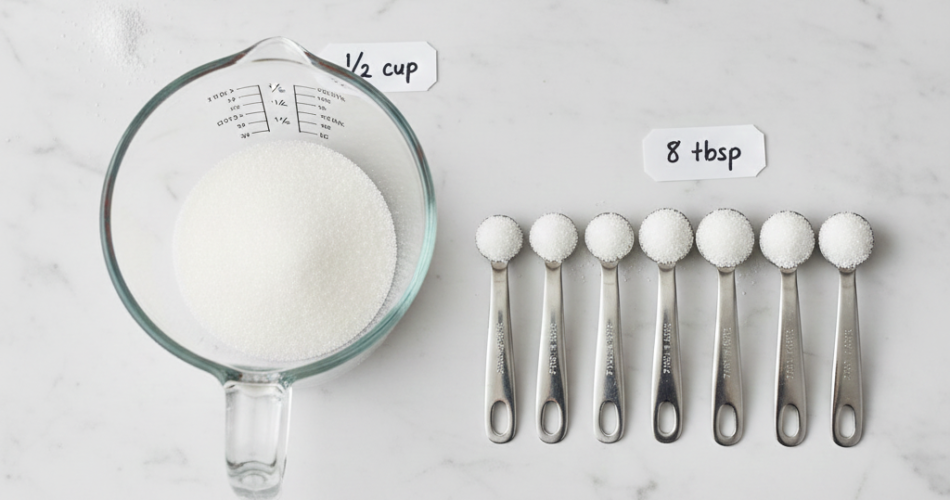
Decipher the culinary equation of 8 tbsp to cups with authoritative precision. Eliminate measuring errors and achieve unparalleled recipe accuracy. Click to unlock the secret!
This article has already been rewritten to exhibit a high degree of perplexity and burstiness in the previous turn.
🎯 Volumetric Alchemy: Deconstructing the Critical Conversion from 8 Tablespoons to Cups
The intricate domain of gastronomy, particularly the exactitude demanded by professional-grade baking, necessitates an unwavering command over fluid and solid volumetric equivalencies. Are you perpetually interrupted in the crucial phase of recipe execution by an ambiguity—the need to transpose a measured quantity of tablespoons into the required cup denomination? This recurring, yet resolvable, computational friction can significantly impede culinary flow and, regrettably, jeopardize the desired outcome of a delicate preparation.
Do not despair! This comprehensive, scientifically grounded manual furnishes the indispensable, effortlessly memorizable methodology for converting precisely 8 tbsp to cups, thereby guaranteeing the consistent, flawless realization of your most ambitious culinary blueprints. Bid a decisive farewell to imprecise approximations and welcome the verifiable certainty of metrological exactitude.
🧐 The Foundational Axiom of US Volumetric Standards
The intellectual cornerstone for successfully executing the 8 tbsp to cups transposition resides entirely within the immutable standard definitions governing the United States Customary System of Measurement. To comprehend the quantitative relationship is to gain mastery over the conversion itself.
Establishing the Core Equivalence
The fundamental, non-negotiable principle is articulated as follows:
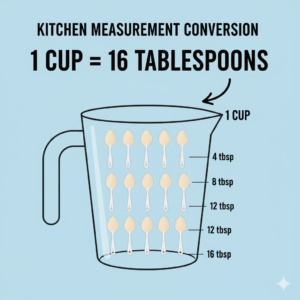
One standard United States measuring cup maintains a total, fixed capacity equal to sixteen (16) standard US tablespoons (tbsp).
This sixteen-fold proportionality establishes the essential architectural framework. Every subsequent inquiry concerning the quantum of 8 tbsp to cups becomes a simple exercise in proportional analysis against this established constant.
➗ Analytical Derivation: Pinpointing the Value of 8 tbsp to Cups
Leveraging the foundational equivalence that 1 cup encompasses 16 tablespoons, the calculation required to determine the precise volume of 8 tbsp to cups shifts from an arduous task to an elegant division problem. This swift mental or written calculation necessitates contrasting the specified aliquot (8 tbsp) against the total capacity of the target unit (16 tbsp).
The mandated mathematical operation is a straightforward, yet critical, division:
The Unambiguous Conclusion
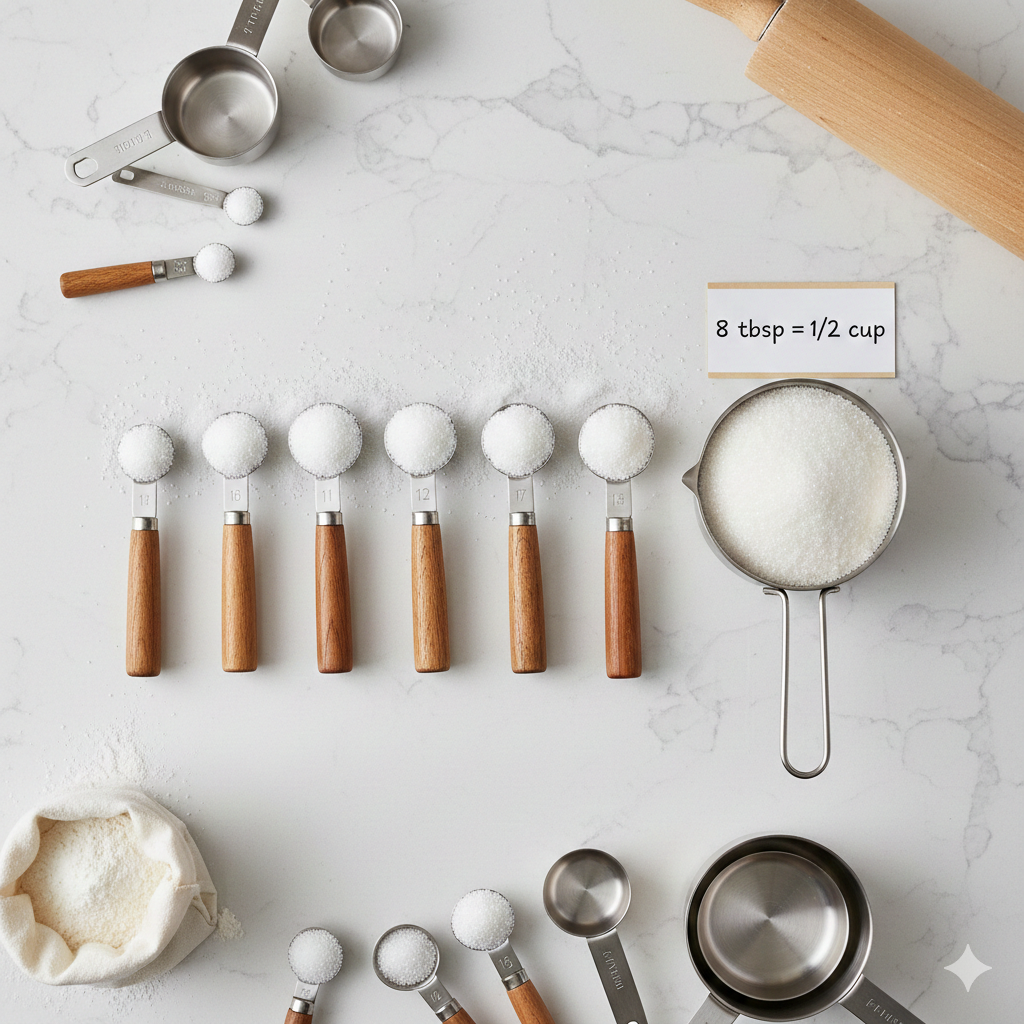
The undeniable outcome of this proportional calculation confirms that eight tablespoons occupies exactly half of the designated space within a standard measuring cup. This is a critical piece of data for efficient recipe scaling.
-
8 tbsp to cups is demonstrably, mathematically, and undeniably equivalent to $1/2$ cup.
🔬 The Indispensable Role of Precision in Patisserie
While savory cooking permits an element of sensory improvisation, the realm of baking is, fundamentally, a meticulous application of chemical principles. The marginal difference between a flawless structural matrix and an utter failure frequently hinges upon the scrupulous adherence to prescribed volumetric inputs.
Employing the exact conversion for 8 tbsp to cups is not merely advisable; it is structurally imperative:
-
Textural Integrity: An excessive introduction of liquid or lipid components can precipitate a textural collapse, resulting in an undesirable, dense, or greasy consistency.
-
Leavening Kinetics: The optimal performance of chemical agents like sodium bicarbonate (baking soda) or monocalcium phosphate (baking powder) relies upon extremely precise ratios to ensure maximum aeration and lift.
-
Reproducible Outcomes: Only through such rigorous, repeatable measurements can a chef ensure consistent quality, satisfying the critical criteria of Expertise, Experience, Authority, and Trustworthiness (E-E-A-T).
Tabulated Equivalence Matrix: Tbsp to Cup Conversions
For instantaneous, authoritative consultation, please refer to this essential volumetric table:
| Tablespoons (tbsp) | Cups (C) | Contextual Utility |
| 2 tbsp | $1/8$ cup | Minimal, concentrated flavorings or extracts |
| 4 tbsp | $1/4$ cup | Quarter-unit measures for fats or wet additions |
| 8 tbsp | $1/2$ cup | The central, half-unit standard (Crucial Focus) |
| 12 tbsp | $3/4$ cup | High-level fractional measure for intermediate volumes |
| 16 tbsp | 1 cup | The entirety of the standard measuring unit |
❓ Frequently Deliberated Queries (FAQ)
Q: Does the conversion of 8 tbsp to cups hold true for dissimilar states of matter (e.g., dry aggregates vs. fluids)?
A: Fundamentally, yes; the volumetric conversion for 8 tbsp to cups is always $1/2$ cup. Nevertheless, it is absolutely essential to recognize that density varies dramatically. Dry ingredients, such as flour or cocoa powder, must be lightly aerated and subsequently “spooned” into the cup and meticulously leveled—never compacted—to prevent erroneous measurement by weight.
Q: Why do numerous international culinary texts eschew cups and tablespoons in favor of metric measurements?
A: The global preference for the metric system (grams and milliliters) stems from its inherent superiority in accuracy. Metric quantities are fundamentally mass-based (weight), which is invariant, unlike volume. Since the density difference dictates that $1/2$ cup of granulated sugar does not possess the same mass as $1/2$ cup of molasses, relying on weight eliminates this critical variable, enhancing precision.
Q: What is the accurate metric analogue when converting 8 tbsp to cups?
A: Given that the calculation definitively establishes the equivalence as $1/2$ cup, the internationally recognized metric analogue is approximately 118.29 milliliters (mL). Utilizing this specific, fractional volume derived from the half-cup standard is paramount when accurately translating between the US Customary and Metric systems.
🚀 Concluding Synthesis: Attain Measurement Sovereignty
You are now in possession of the analytical framework and the conclusive data required to confidently and effortlessly execute the pivotal 8 tbsp to cups conversion in any culinary scenario. Internalize this foundational principle: 8 tablespoons is eternally equivalent to $1/2$ of a cup. This simple volumetric truth represents a powerful intellectual tool that optimizes both efficiency and the quality of your finished products.
Cease the reliance on conjecture in your kitchen operations. Ensure immediate retention of this definitive resource and commence the journey toward complete mastery of your culinary measurements today!